One rulebook
The crash rules, the round, the fairness, the crowd and the progression live in Shared/PropBetCore, a pure C# package. The demo runs it locally, and the provider runs the same files, kept in step by sync_rules.py.
Cosmic Cliffs, Carina Nebula · NASA, ESA, CSA, STScI


A two-seat biplane climbs from an airfield, through the clouds and out into space while the multiplier rises. Cash out before it busts.
PropBet started out as a 2D canvas crash game in my Next.js arcade. This version is a complete 3D rebuild in Unity 6. A two-seat, open-cockpit biplane waits on the airfield with a pilot in each seat, one for each of your bet panels. It rolls down the runway, lifts off and climbs over farmland and mountains, through the clouds and the stratosphere and out into space, while the multiplier rises until the round busts.
Cash out and your pilot stands up, leaps over the side, free-falls and drifts away under a parachute. In the arcade, it plays on the game provider’s shared crash table, so everyone at the table watches the same flight, with a live list of real players’ bets, and stakes are settled through the operator’s wallet. Offline, it runs the same rules as a demo with a simulated crowd.
The higher the plane climbs, the more it pays, so you can read the odds just by looking out of the cockpit.
Each bet panel has its own pilot, and cashing out is something you see happen, not just a number that changes.
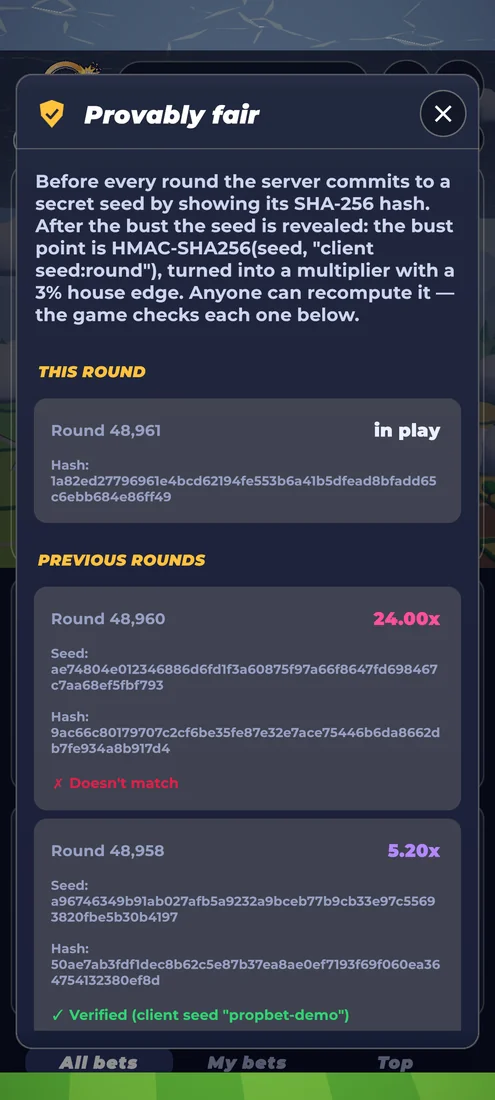
Every round’s seed hash is shown before take-off and the seed after the bust, so anyone can check the result.
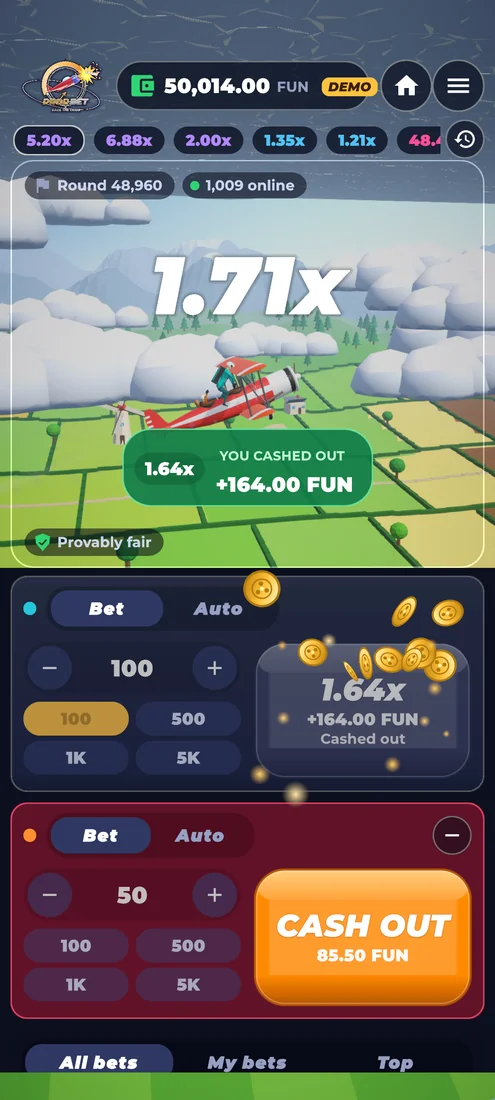
These screenshots were captured straight from the game. Tap any of them to see it bigger.
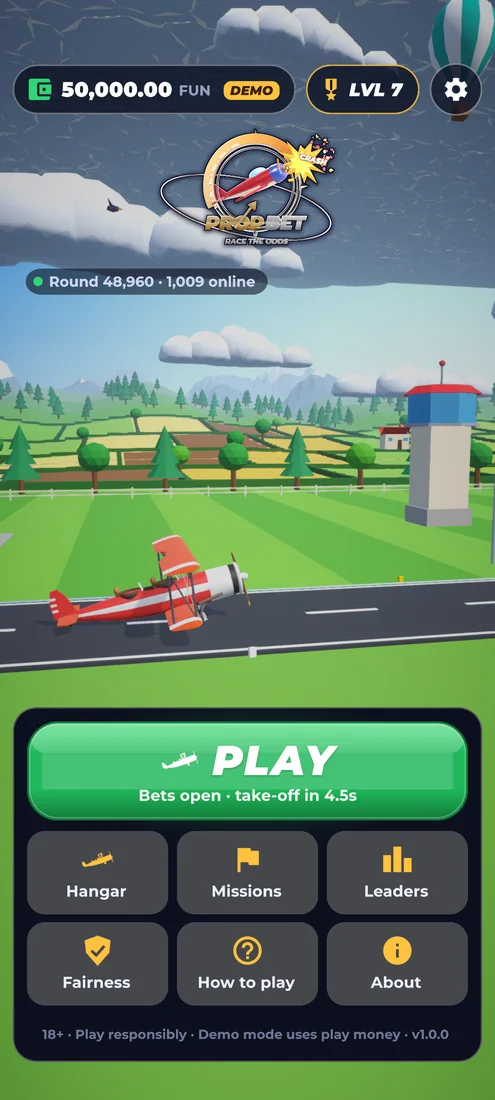
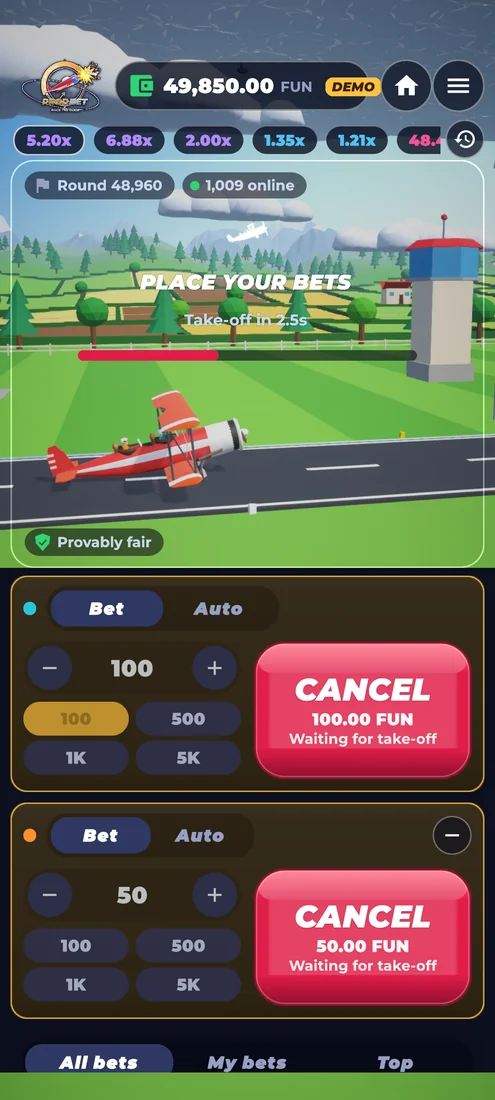
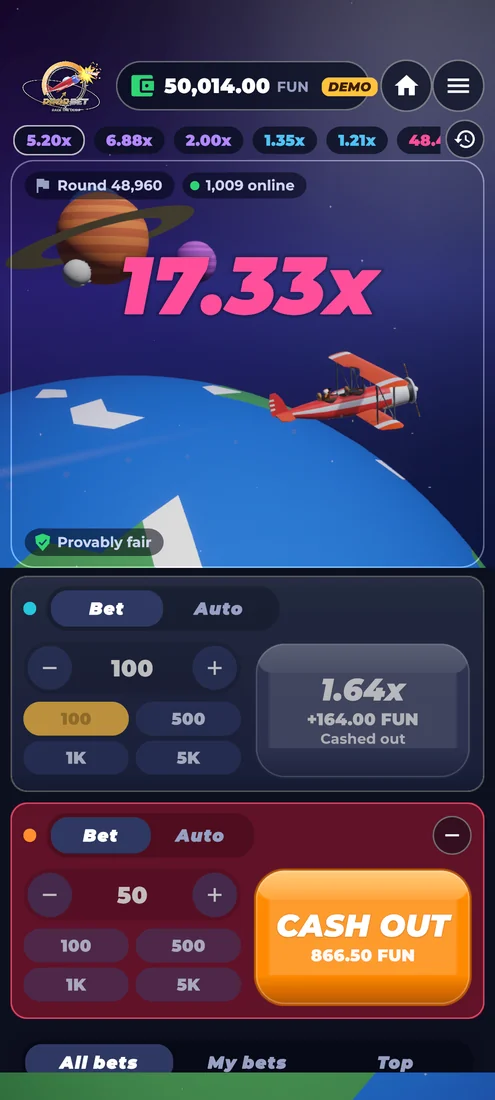
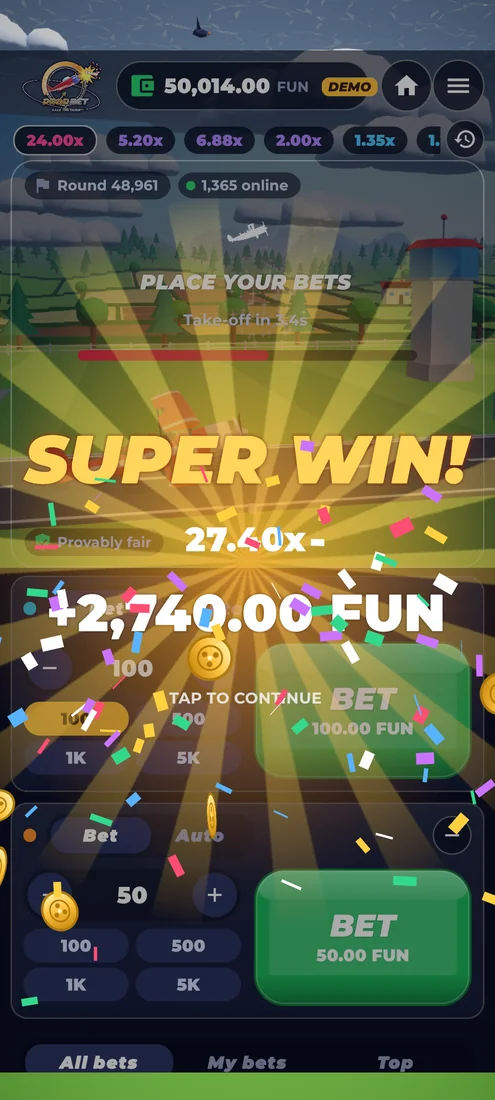
During the 6-second countdown, stake one or both bet panels, with an optional auto cash-out anywhere from 1.01× to 1,000×.
The plane rolls down the runway for 1.5 seconds at 1.00× with no cash-out, then lifts off.
The multiplier rises along e^(0.1·t) from lift-off, reaching 2× after about 7 seconds in the air and 10× after about 23.
Cash out on a panel at any moment to get stake × multiplier. When the round busts, every stake still riding is lost.
When you cash out, the pilot stands up, leaps over the side, falls arched, throws the pilot chute and swings under a ram-air canopy.
The airfield and farmland, then balloons and an airship, a sea of clouds with airliners, the stratosphere, and finally black space with the curve of the Earth and the planets.
Two stakes ride the same flight, each with its own auto cash-out, just like in the original game.
Real players’ stakes and cash-outs on the provider’s table, or a simulated crowd in the demo.
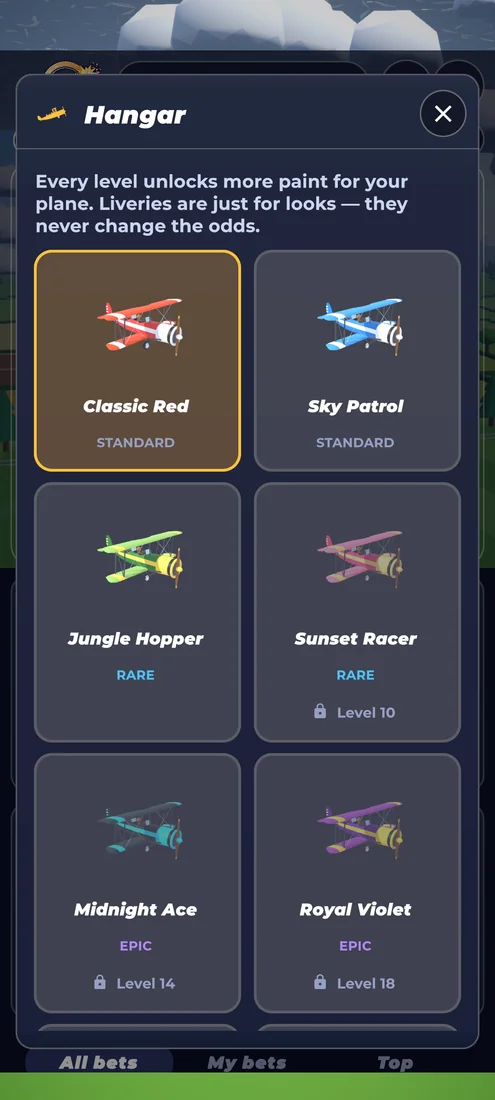
XP across 30 pilot levels, daily missions, a leaderboard and 8 liveries for the plane, which change how it looks and never the odds.
Every past round can be recomputed from its revealed seed, right inside the game.
I made this game on my own, so I handled the design, the code, the art pipeline, the audio and the release.
The crash rules, the round, the fairness, the crowd and the progression live in Shared/PropBetCore, a pure C# package. The demo runs it locally, and the provider runs the same files, kept in step by sync_rules.py.
The chance of reaching x is RTP / x, so about 3% of rounds bust at 1.00×, and the cap is 5,000×. The demo returns 97%, and on the provider each RTP level an operator can pick (90% to 96%) has its own table.
On the provider, one table runs the countdown, the flight and the bust for every player. The game joins it through a small SignalR hub client, sending bets and cash-outs and receiving the round events.
The bust point comes from a uniform draw u as floor(RTP / u). Its seed hash is published before take-off and the seed is revealed after the bust, so the Provably Fair screen can recompute any past round.
build_world.py makes the airfield, hangars, tower, farms, windmill, mountains, clouds and cloud deck, balloons, an airship, airliners, the Earth, the planets, a space station and a satellite.
build_plane.py builds the two-seat biplane and its eight liveries, and build_people.py dresses Quaternius’ rigged man with helmets, goggles, harnesses and the parachutes.
The propeller, wind, take-off roar, explosions and the parachute catching the air are cut and mixed from CC0 and CC BY recordings by a Python script, under Kevin MacLeod music and Montserrat lettering.
Credits. The pilots are built on Quaternius’ rigged man (CC0). The music is by Kevin MacLeod (CC BY 4.0), the sound effects come from Kenney, OpenGameArt, Freesound and Wikimedia Commons creators (CC0, CC BY 3.0 and CC BY 4.0), the font is Montserrat (OFL) and the logo reflections use a Poly Haven HDRI (CC0). The logo, the world, the plane and the interface were made for the game, with no AI-generated art or audio. Everything is credited on the in-game About screen.