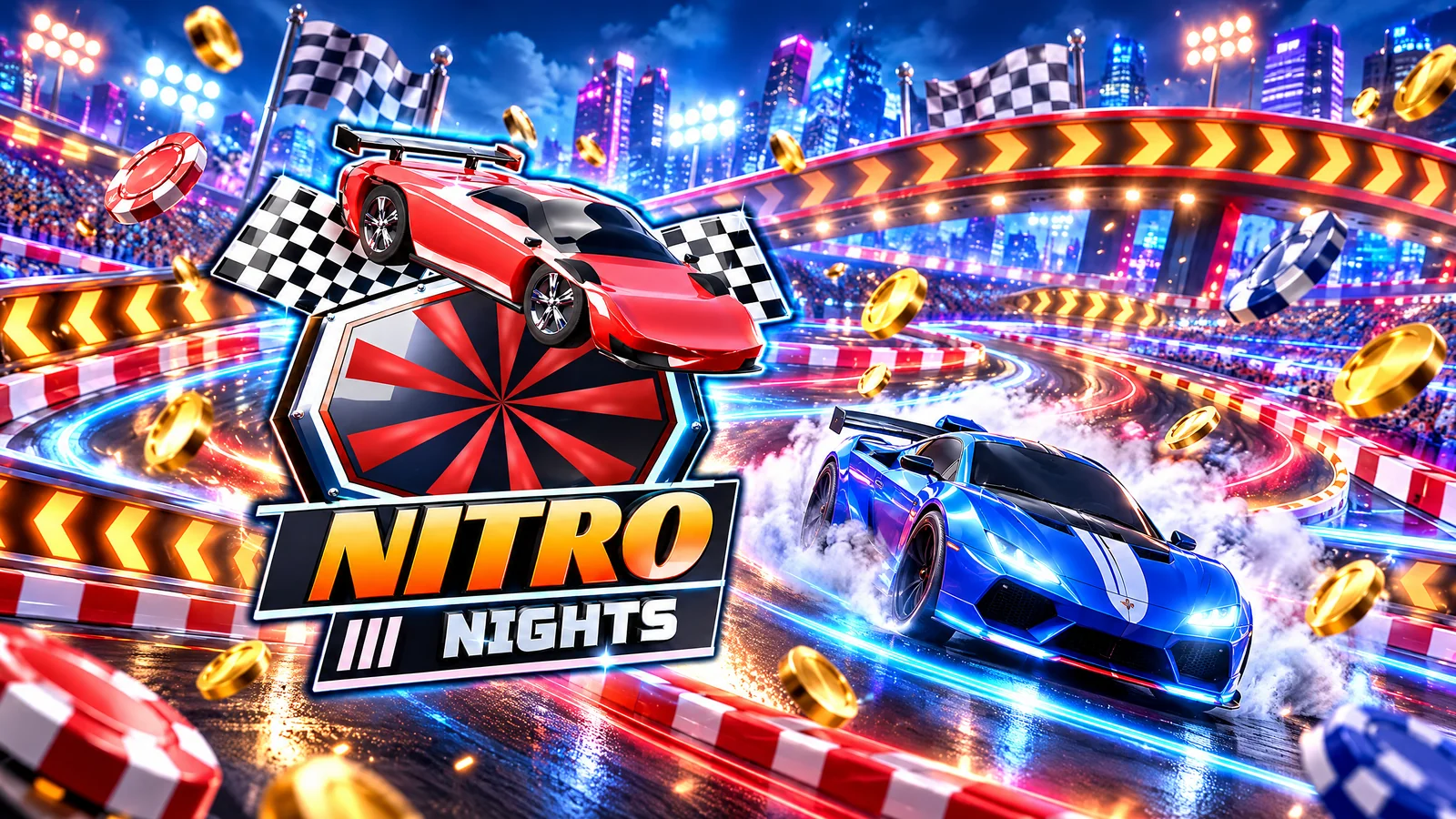
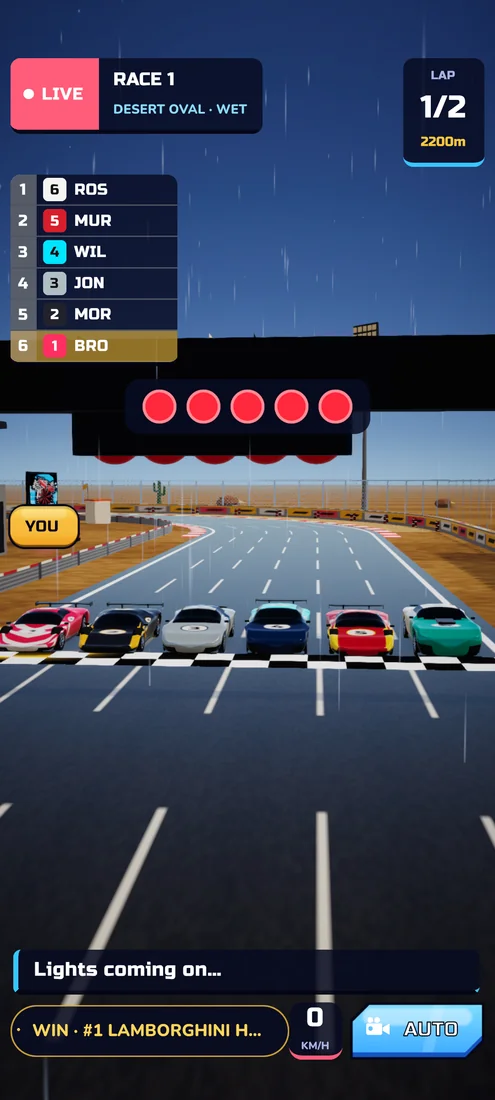
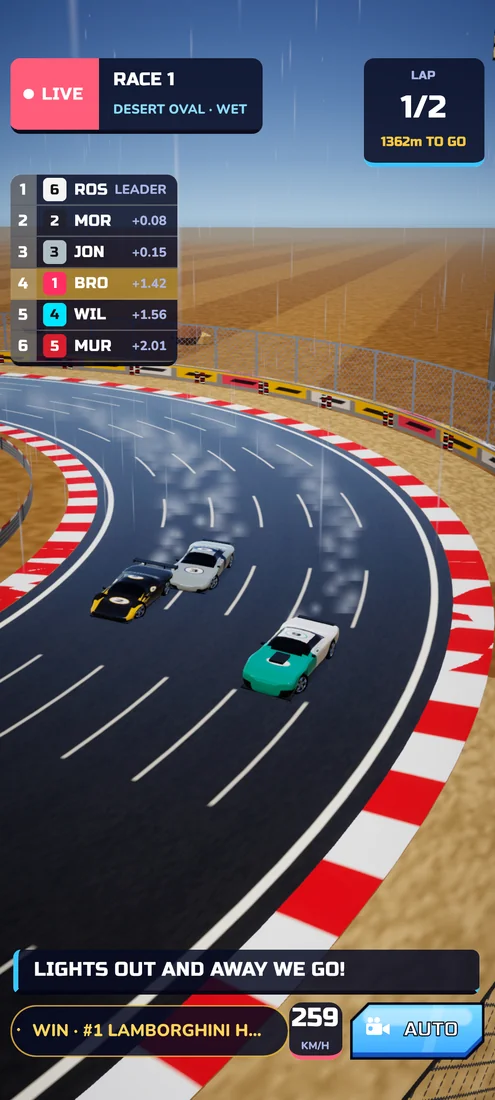
Nitro Nights started out as Ready To Race Unlimited, the car racing game in my Next.js arcade. I rebuilt it in Unity 6 to look like a live night race on TV, with neon colours, dark carbon panels and Russo One lettering. During the race there’s a LIVE tag, a timing tower, five red start lights, a lap counter, a speedo and a commentary ticker on screen.
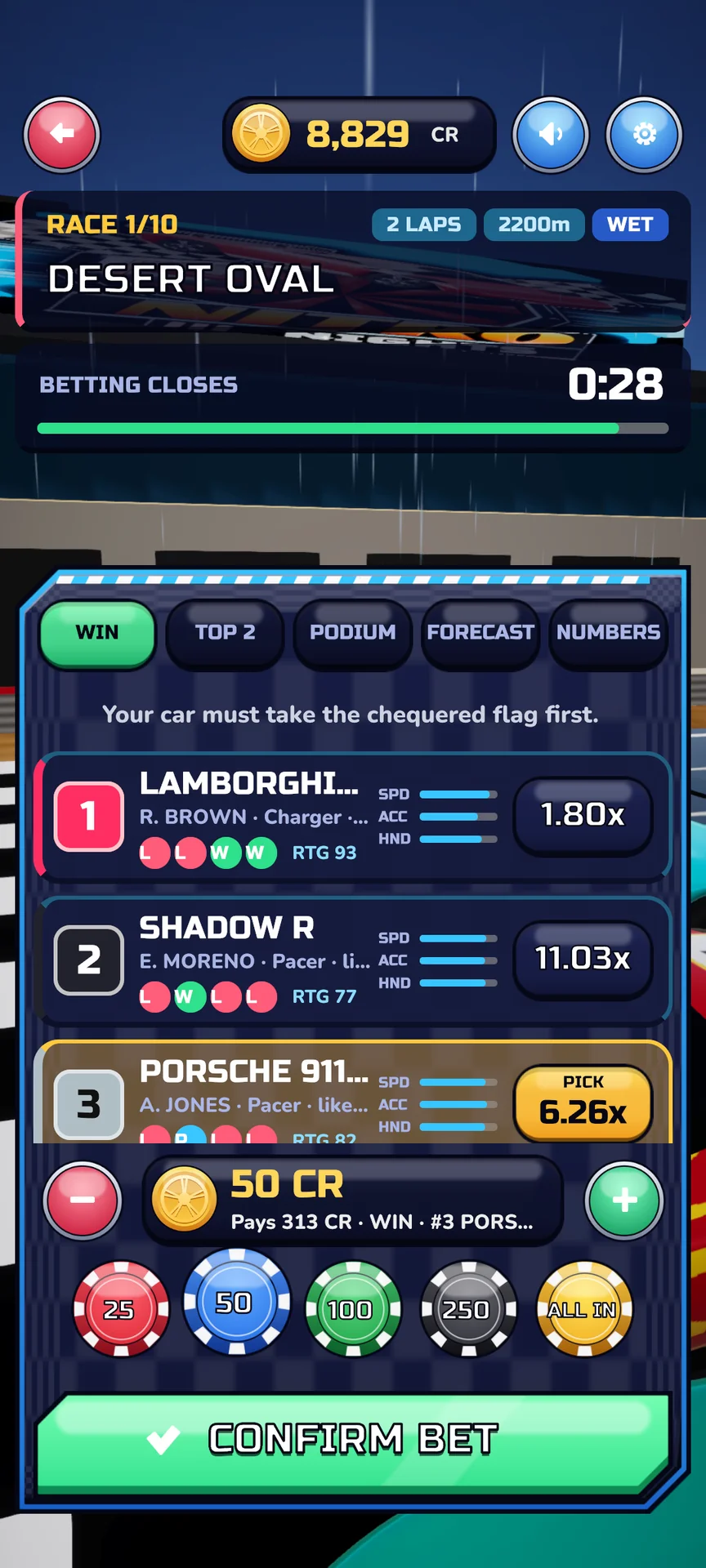
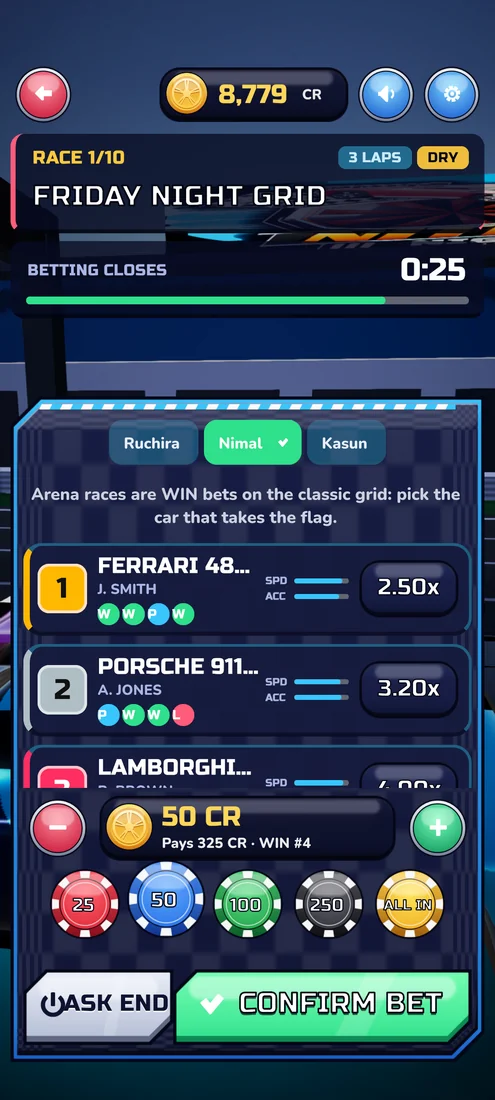
A Quick race session runs 5 to 20 races, and each one opens a 30-second betting window. The race card draws one of four circuits, dry, hot, damp or wet weather, and a grid of six cars with their form, rating, speed, acceleration and handling. You pick a car, choose a market, tap a chip and lock in your bet, and then it’s lights out. In the arcade, every paid race is drawn and settled by the game provider.
Live TV, not a menu
Every screen is styled like a night race broadcast, from the timing tower to the podium board.
Bet against the clock
A 30-second window before every race keeps the pace up, whether you play on your own or in an arena.
Same rules everywhere
One C# rules package runs the offline demo and the provider’s paid races, so the two can never disagree.
02Screenshots
These screenshots were captured straight from the game. Tap any of them to see it bigger.
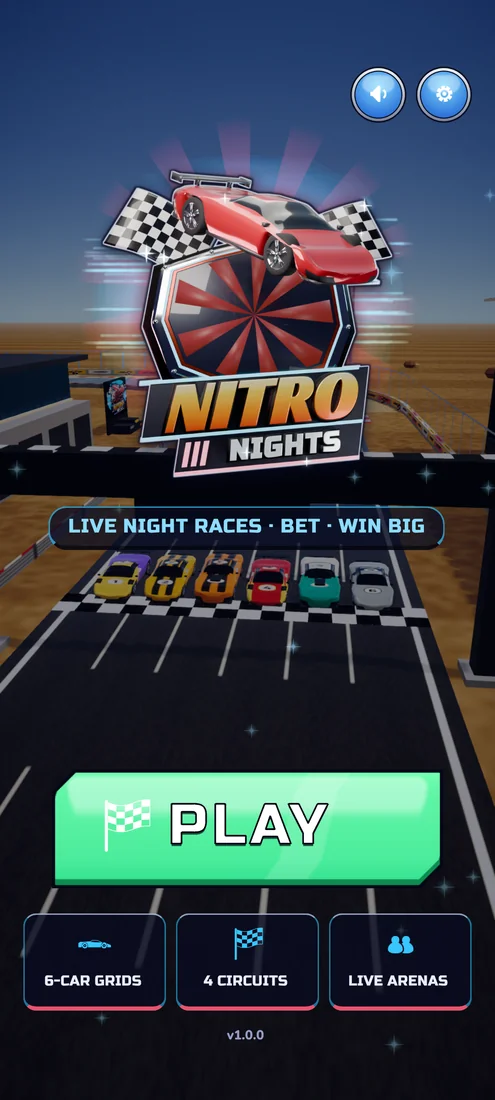
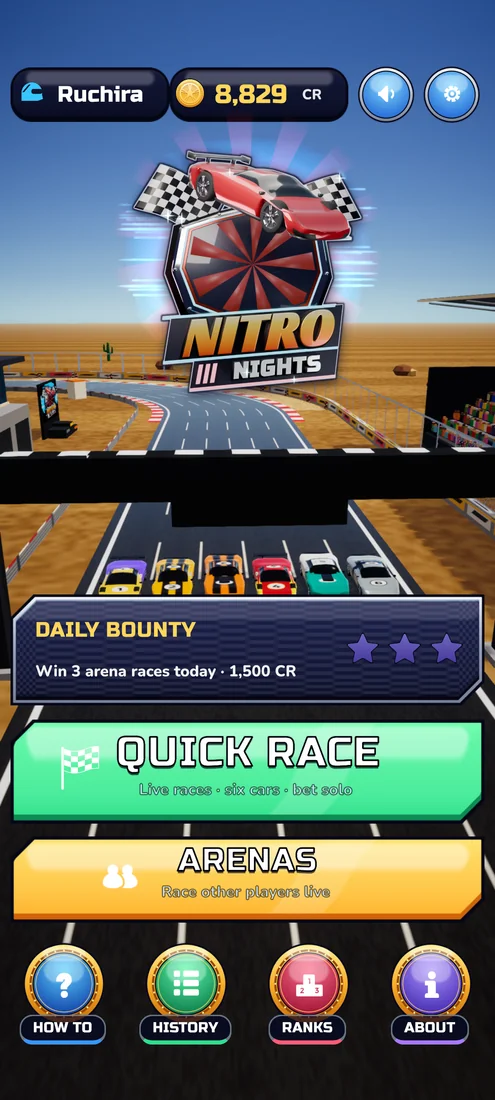
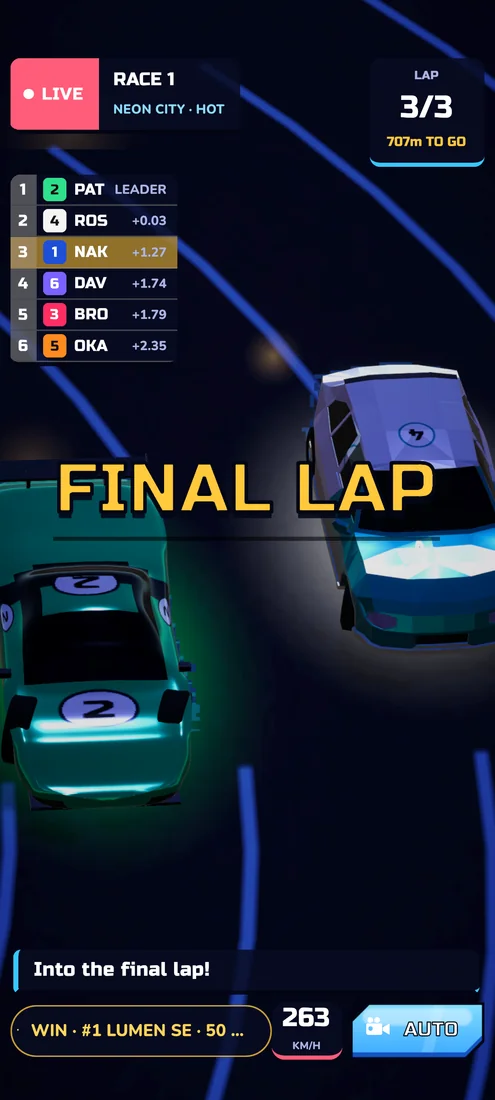
Title screen - the 3D logo over the gridHome - Quick race, Arenas and the daily bountyPicking a car on the race cardFive red lights on the gridDesert Oval in the wetNeon City - into the final lapBetting in an arena with friends
03Core Loop
1
Start a session
Press PLAY and start a Quick race session of 5 to 20 races, or join friends in an Arena.
2
Read the card
Check the circuit, the weather and each car’s form, rating, speed, acceleration and handling while the clock runs down.
3
Lock the bet
Pick a market and a car, type a stake or tap a chip (25, 50, 100, 250 or ALL IN), then confirm and lock it.
4
Lights out
Five red lights, then the race. The podium board shows the time gaps, and you can go to the next race, replay it or head home.
04Key Features
Four circuits
Thunder Circuit in a storm, Sunset Speedway at golden hour, Neon City at night and Desert Oval at noon, with races of 2, 3 or 4 laps.
TV director
The TV, chase, heli, onboard, head-on and finish cameras are cut automatically, or you can pick one yourself.
Live calls
The commentary ticker calls overtakes, the final lap and wheel-to-wheel finishes as they happen.
Five markets
WIN, TOP 2, PODIUM, FORECAST (the first two in order) and NUMBERS, where you bet on the winner’s number being odd or even, high or low.
Weather & effects
Smoke, rain spray, nitro and under-glow, on dry, hot, damp or wet tracks.
Arenas
Rooms with an invite code and a password, a synced 30-second window on the classic six-car grid, a leaderboard and a 1,500 daily bounty for three wins.
05What I Built
I made this game on my own, so I handled the design, the code, the art pipeline, the audio and the release.
I designed the race card, the five markets, the betting window and the arena rules.
I programmed the gameplay and every screen in C#, building the UI in code with UI Toolkit.
I wrote the race rules as a standalone C# package that the game provider also compiles and runs.
I built the Blender Python pipeline that makes eight of the twelve cars, the circuit kit and the 3D logo.
I also synthesised the engine sounds in Python, wrote a script that generates the stylesheet, and built the device screenshot and camera tour tests.
06Under the Hood
Rules outside the engine
The race card, the race engine, the classic race, the race film and the garage live in Shared/RacingCore, a pure C# package with no Unity in it. The client runs it for the offline demo, and the provider runs the same files for paid races.
The race is a film
The client sends the card seed, the bet and the price it showed. The provider draws the finishing order and settles the bet, and the 3D race is just a film of that order, so it can’t decide anything.
Synthesised engines
The V8 loops at idle and full revs, the roar of the field, launches, fly-bys, tyre screech, nitro and the start-light beeps are all generated by a Python script rather than recorded.
A generated stylesheet
build_uss.py writes the game’s UI Toolkit stylesheet, so the panels, chips and buttons share one set of sizes and colours across ten screen shapes.
07Art & Audio Pipeline
Twelve cars, one rig
build_cars.py makes eight bodies (hyper, wedge, GT, tuner, muscle, prototype, rally and fastback GT) and brings four Quaternius cars onto the same rig, with wheels, glass, lights, liveries and race numbers.
A whole circuit kit
build_circuit.py builds the start gantry and lights, grandstands with a crowd, the pit building, control tower, podium, big screens, tyre stacks, light towers, billboards, a city skyline and a blimp.
Skin, type & music
The carbon panels, chips and trophies are drawn in Python, with Kenney icons and Russo One, Racing Sans One and Nunito lettering. Each screen has its own Kevin MacLeod track, under real crowd recordings and Kenney sound effects.
08Challenges & Solutions
ProblemWith a 30-second clock, players run out of time halfway through placing a bet.
SolutionIf the clock runs out with a car selected, the bet is locked for you. With nothing selected, you simply watch the race.
ProblemA TV director is hard to judge from one playthrough, because the cuts happen fast.
SolutionA camera tour test photographs a whole race every 1.5 seconds and names each frame after the director’s shot, so I could review the cutting as a strip of images.
ProblemThe layout has to work on everything from a 480p phone to flip covers and tablets.
SolutionA PlayMode test plays through every screen on ten screen shapes and saves the captures, which made layout fixes something I could check rather than guess.
Sharing one rules package between two racing games (and the provider) meant fixing a bug once fixed it everywhere.
Synthesising engine sounds gave me loops that line up perfectly with the revs, which recordings never quite did.
Camera work is easier to judge from a contact sheet than from watching the race over and over.
Credits. Four of the twelve car bodies are Quaternius models (CC0), the icons and most sound effects are Kenney’s (CC0), the crowd recordings are Gregor Quendel’s (CC BY 4.0), the music is Kevin MacLeod’s (CC BY 4.0) and the fonts are Russo One, Racing Sans One and Nunito (OFL). The engines are synthesised and the other cars, the circuit and the logo were made in Blender, with no AI-generated art or audio in the game. Everything is credited on the in-game About screen.